What Biographies Can Teach Us About Constructing Narratives
I love reading a variety of fiction genres including science fiction and literature classics. For non-fiction I love topics around design, psychology, philosophy, culture, technology and … biographies.
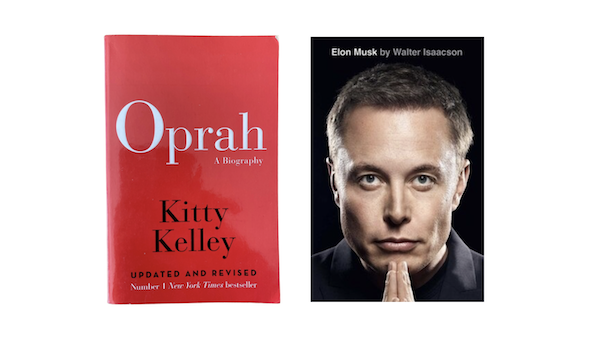
Over the past summer I read the biographies about two very different individuals: Oprah Winfrey and Elon Musk. The experience of reading them back-to-back, was an opportunity to reflect on what I find fascinating about biographies. I also realised there was a lot one can learn about constructing narratives and character development.
Biographies: Worlds Within Worlds
Besides personal curiosity around one of this century’s most interesting and contentious individuals in tech, I was keen to read “Elon Musk” as it was written by American journalist Walter Isaacson. I am a fan of Isaacson’s meticulous research, interview skills, and writing style as well as his ability to construct tightly weaved narratives which reveal new insights about many well-known individuals including Steve Jobs, Einstein and Jennifer Doudna.
When writing biographies, Isaacson has as much open access as his subject will allow. As an experienced and well-respected writer, he is able to conduct interviews with his subjects that facilitate an ease and introspection, perhaps sometimes revealing things that were previously unknown to the subject themselves.
This access often extends to the close inner circle including spouses, parents, siblings and friends. One often wonders why his subjects (many who are already rich, famous and powerful) would agree to opening up their life to scrutiny. To share what they have learned? A chance to set the record straight? Ego? One can only speculate but it makes for fascinating reading.
Elon Musk follows the tech entrepreneur from his formative years in South Africa to early tech startups in the US and charts his personal relationships with family and friends along the way. There are incredible insights into the way Musk thinks, his appetite for risk and the way he sees the world. Isaacson is well aware of Musk’s current reputation but doesn’t fall into easy assumptions. Instead he artfully weaves his subject’s weaknesses and strengths against a backdrop of a world dealing with rapid global technological progress.
In contrast, an unauthorised biography such as “Oprah: A Biography” by Kitty Kelley, is a considerable challenge given that the author must construct a narrative entirely without the subject’s input or permission.
Kelley is known for unauthorised biographies about people who often splashed across magazine covers including Jacqueline Kennedy Onassis, Elizabeth Taylor, Frank Sinatra, the British royal family, and the Bush family.
I didn’t enjoy Kelley’s structural and writing style for a number of reasons.. Firstly, I prefer a chronological approach which foreshadows or teases events that come later. Kelley skipped around far too much – missing important events or not providing the emphasis that it deserved – in favour of making a specific point. Oprah’s ascent came at such a fascinating time of broadcast television and particularly later as the landscape shifted towards online, Kelley missed an opportunity to examine how Oprah was both influenced by these events as well as an agent of change later herself.
Secondly, without access to the subject herself and close inner circle, Kelley must resort to information which is publicly available – and that everyone has already read. Apart from quotes from distant relatives and old acquaintances (does the opinion of someone who knew her at college really count?) it’s difficult to feel that this provides any new insights. It felt shallow. Although this is the shortcoming of all unauthorised biographies, I feel that other authors - like Issacson who has written biographies of people who have long passed - are still able to contract a meaningful and insightful narratives, by truly understanding the individual and seeing the decisions that they have made through the lens of their life experience.
The Art of Constructing Narrative Across A Life Arc
It is such an art to craft a cohesive narrative from someone’s entire life.
The inscription on a tombstone is perhaps the shortest version. An obituary the next, and then perhaps a eulogy.
Hindsight reveals the pivotal decisions, sliding door moments and forks in the road that lead to later success (or demise). But you can’t allude to too much, too early.
Here are some of my personal takeaways about constructing narrative and character development that I have learned from reading biographies over the years:
I love attention to the small details and small moments of these lives. The impact of reading a certain book as a child, an inspiring phrase shared at a critical time that somehow embeds in the brain or a chance meeting that changes everything.
Establish the overall arc that is compelling to readers. Rags to riches? Destiny? Belief in oneself despite the odds?
Are there formulas to the character’s success (or failure) which lends itself to deeper narrative themes? Luck + hard work? Privilege + luck? Right place + right time? Genetics + hard work?
Do things happen to the subject or is the subject driving their own lives?
Clear sailing is a boring story. Readers love the ups and downs, the unexpected twists and turns of fortune. Misfortune reveals so much more about a character than the good times.
Contrasting events against social, cultural and political events places the story within a wider context. We are all influenced by the times we live in.
Appreciate or anticipate how much (or little) information the reader may have about a particular person, place or moment in history.
The same facts can be used to construct an entirely different narrative by changing a character’s motivation.
Summary
I think the biggest hook for biographies are the promise that they will reveal something new about it’s subject. Readers are hungry for secrets and a quest for the truth. What’s the secret of their success? Why did they do it? What drives them? Is it worth it? Are they happy?
We can also potentially see ourselves, or contrast our lives, with these individuals. Is their life similar to ours or radically different? How pivotal have moments in our childhood been to impact on where we are today? Where are the sliding door moments in our own lives?
Because whether we realise it or not, we all construct narratives about our lives. We explain how things came to be based on the events that came before. As if life is that straight forward and linear. In reality things are much messier. There are two sides (or more) to every story. There are heroes and villains (depending on who you ask).. Triumphs and tragedies. Things we manifested and things that were beyond our control.
But the truth is rarely contained within facts. Rather, one truth may be revealed through an unfolding narrative which already knows the ending of the story. The art is crafting the journey of how we get there.